On August 12, 2026, Burgos will experience an event that won't happen again for over a century: a total solar eclipse visible across the entire province. For one minute and forty-four seconds, the Moon will completely block the Sun at sunset, turning day into night above the towers of the Cathedral. Hotels have been fully booked for months. A massive influx of national and international visitors is expected.
But if you're travelling to Burgos for the solar eclipse 2026, what is there to see for the rest of the day? Totality doesn't begin until 8:29 PM, leaving the entire morning and afternoon free to discover a city with far more to offer than its famous Cathedral.
In this article, we suggest the perfect plan: walk The Merchants' Route (La Ruta de los Mercaderes), a cultural itinerary of less than one kilometre through the upper town of Burgos that connects six centuries of history, art and international trade in a single stroll.
Solar eclipse Burgos 2026: what to see before looking at the sky
The province of Burgos sits in a privileged position within the eclipse's totality path. The Provincial Government has launched the programme "Burgos te eclipsa" (Burgos eclipses you), with six designated observation zones, a travelling mobile planetarium and a full calendar of cultural activities throughout the summer.
What many visitors don't yet know is that the eclipse will occur at sunset. That leaves the whole day free to explore the most fascinating and least-known part of the city: the upper town, where the great merchants who turned Burgos into Europe's trading capital once lived.
The medieval "golden mile": Burgos's best-kept secret
When you search for what to see in Burgos in one day, most guides list the same highlights: Burgos Cathedral, the Arco de Santa María, the Museum of Human Evolution, the Espolón promenade. All unmissable. But the city hides a treasure that most tourists walk right past: Calle Fernán González.
In the 15th and 16th centuries, this street was the most exclusive address in Burgos. The "golden mile" where the great merchant dynasties lived — families like the Polancos, Maluendas and Castros, who traded wool, fine linens and luxury goods with Flanders, England and France through the powerful Consulado del Mar (Merchant Marine Consulate).
A 1527 travel account described the city thus: most of its residents were wealthy merchants who conducted business not only across Spain but all over the world. They had fine houses, lived handsomely, and were the most courteous and honourable men the writer had seen in Spain. All that wealth was poured into art — monumental altarpieces, Flemish tapestries and funerary chapels designed to secure both earthly status and eternal salvation.
And it's all still there, less than a kilometre from the Cathedral, waiting for those who know where to look. That is precisely what The Merchants' Route offers.
What the Merchants' Route includes: two churches, three palaces, one street
The Merchants' Route is a self-guided walk that unifies the upper town of Burgos into a single visit. In less than one kilometre, you'll explore two extraordinary Gothic churches — San Nicolás de Bari and San Gil Abad —, three civic palaces — Castilfalé, the Casa del Cubo and Capitanía — and elements of the Cathedral itself that only make sense in the context of medieval trade, such as the Golden Staircase and the Pellejería Gate.
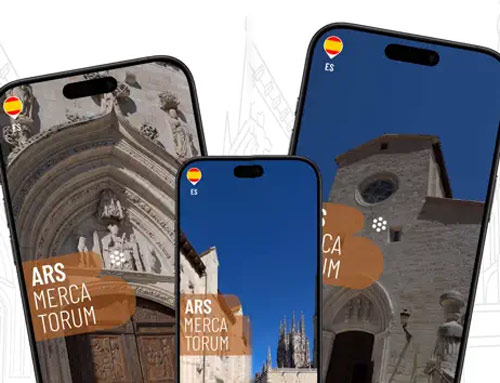
The route is fully operational with online ticket sales, a mobile app with audioguides and 360° views, and a continuous opening schedule from Monday to Sunday. Check the updated prices and opening hours on the official website.
Church of San Nicolás de Bari: "the meeting point between heaven and earth"
Just steps from the Cathedral, up a short flight of stairs, you'll find San Nicolás de Bari. From outside, it's unassuming. Inside, it's breathtaking.
Its main altarpiece is one of the great masterpieces of late Spanish Gothic art. Unlike typical altarpieces carved in wood, this one is sculpted in polychrome Hontoria limestone gilded with gold leaf. It was created by Simón and Francisco de Colonia, the same artists who designed the Cathedral's iconic spires. A staggering 464 figures are carved with such precision that experts have described the work as "stone goldsmithery".
The altarpiece tells the life of Saint Nicholas of Bari, the 4th-century bishop whose generosity towards children would eventually inspire the figure of Santa Claus. The lower section depicts earthly scenes in square compositions. The upper section unfolds concentric circles representing heaven, with angels swirling around the Holy Trinity crowning the Virgin Mary. It is, quite literally, a visual bridge between earth and sky.
Don't miss the Last Judgement Panel, a monumental Hispano-Flemish painting from around 1500–1510 clearly influenced by Van der Weyden; or the Tapestry Museum, Spain's most important parish tapestry collection, featuring nine 16th-century tapestries woven in Oudenaarde (Belgium) depicting the biblical heroine Judith, and three 17th-century tapestries from Bruges about the life of Jacob.
Church of San Gil Abad: the great merchants' pantheon
San Gil Abad is a 13th-century Gothic church built over the old Romanesque church of San Bartolomé, at one of the main gates to the walled city. Its strategic location beside the gateway to European trade made it the favourite church of the Burgos bourgeoisie. With around twenty historic burials, it is essentially the great pantheon of the city's merchant class.
The Chapel of the Holy Christ of Burgos (also known as the Chapel of the Holy Drops) is perhaps the most striking space. Commissioned from Juan de Vallejo — the architect of the Cathedral's lantern tower — it houses a dramatic Gothic crucifix. Legend has it the image bled after being struck by a falling stone in the 14th century. Tradition records that King Philip II, upon seeing it, declared that anyone who had lost their faith would find it there.
The Nativity Chapel stands out for its octagonal star vault — symbolising the "eighth day", the day of resurrection in Christian tradition — and an altarpiece attributed to Felipe Vigarny with twelve scenes from the life of the Virgin. It also holds the baptismal font where Blessed Diego Luis de San Vitores, Jesuit missionary and martyr in the Mariana Islands, was baptised.
The Chapel of the Good Morning (Buena Mañana) has a special connection to Spanish history: Saint Teresa of Jesus prayed here every morning during her stay in Burgos to complete her final convent foundation.
The palaces and the Cathedral through a merchant's lens
The walk between both churches passes the Castilfalé Palace (1544), now the Municipal Archive, built for the merchant Nicolás de Gauna and whose underground spring caused a famous lawsuit with the Cathedral in 1633. You'll also pass the Casa del Cubo, a 15th-century palace that now serves as the pilgrim hostel on the French Way of the Camino de Santiago, and the Capitanía Palace, built on the site of the legendary Palace of the Four Towers.
The Cathedral's Golden Staircase, designed by Diego de Siloé in 1519, has a delightful backstory tied to commerce: merchants had been using the Cathedral as a shortcut, crossing it with carts of meat, wineskins and even live animals. Chapter records from 1465 already banned the practice, to no effect. The solution was this ingenious staircase, which made it impossible to cross with loaded saddlebags. Ingenuity, beauty and practicality at the service of a booming trading city.
The Altarpiece Museum: the Route's third church
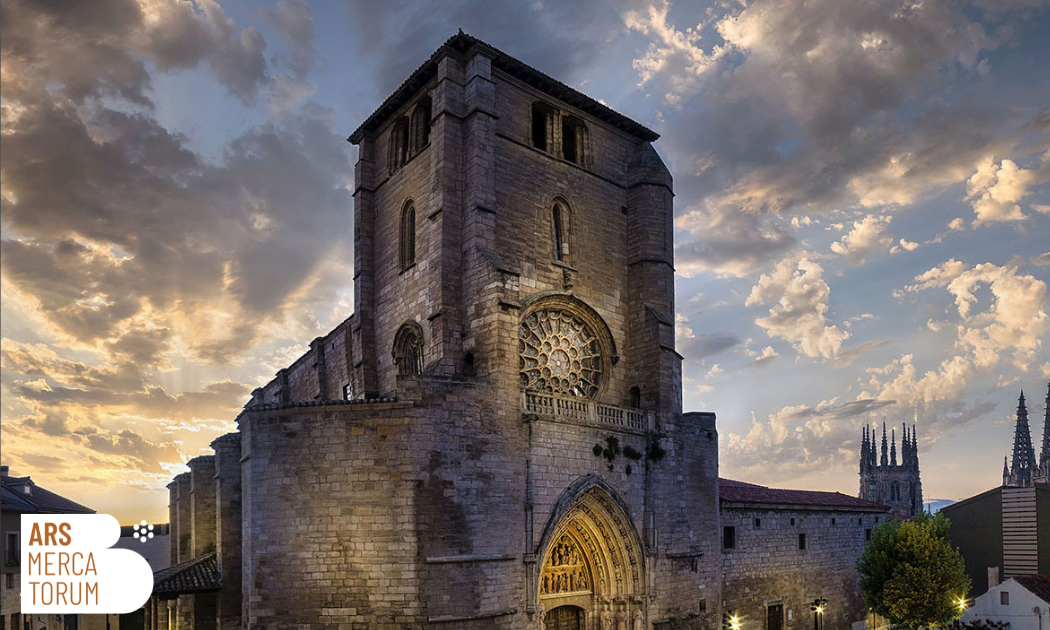
The Route also offers the chance to visit the Altarpiece Museum, housed in the imposing Church of San Esteban. It holds a unique collection of restored altarpieces from every period, completing the panorama of sacred art in Burgos. With the 3-church combined ticket (€7), you gain access to all three venues.
Between heaven and earth: why this route connects with the eclipse
There is a poetic coincidence worth noting. Burgos's official tourism slogan for the eclipse is "between heaven and earth". And that is exactly the concept that underpins every work of art on the Merchants' Route.
The altarpiece of San Nicolás was designed as a "trapdoor open to the sky": earth below, eternity above. The funerary chapels of San Gil are microcosms where the vaults represent the celestial vault. The merchants invested fortunes because they believed that earthly beauty was a reflection of heavenly glory, and that charity was the path to reach it.
On August 12, when the Moon hides the Sun over Burgos, thousands of people will experience that connection between heaven and earth. But those who have walked the Merchants' Route that same morning will know that the people of 15th-century Burgos were already seeking that very connection — and found it in stone, in gold, and in woollen thread woven by hand at two square centimetres a day.
Practical guide: planning your visit for the solar eclipse Burgos 2026
When to do the route: It takes 2–3 hours at a relaxed pace. If you're coming for the eclipse, the morning or early afternoon of August 12 is ideal, since the eclipse doesn't begin until 7:33 PM. You can also do it the day before or after.
Opening hours: Monday to Sunday, 11:30 AM – 7:00 PM. Continuous schedule, no midday closure.
Tickets and prices:
- Church of San Nicolás de Bari: €4
- Church of San Gil Abad: €4
- Altarpiece Museum: €4
- Combined ticket, 2 churches: €6
- Combined ticket, 3 churches: €7 (best value)
- Reduced and free rates available (check conditions)
👉 Buy your combined ticket here
Mobile app: Download the official Route app, available free for iOS and Android. It features geolocated "Point to Point" itineraries, offline audioguides and the "Peek In!" function with immersive 3D and 360° views of the chapels and spaces.
The walk: Start at San Nicolás de Bari (next to the Cathedral), head up Calle Fernán González past Castilfalé, the Golden Staircase and the Pellejería Gate, the Casa del Cubo, and finish at San Gil Abad. Less than one kilometre with constant stops.
Eclipse day tip: Do the route in the morning, have lunch in the old town (Burgos's blood sausage — morcilla — and roast lamb are a must), then head to your chosen observation point in the afternoon. The Castle, at the top of the city, offers a clear horizon and a spectacular end to a day you'll have started gazing at the merchants' stone sky and finished gazing at the real one.
Five reasons to come back to Burgos after the eclipse
The Merchants' Route is open year-round. If the eclipse brings you to Burgos for the first time, here are five reasons to return:
- The Camino de Santiago passes right through here. San Gil Abad stands at one of the historic entrances of the French Way into the city. The Casa del Cubo is now the pilgrims' hostel. The Jacobean context immensely enriches the visit.
- The Flemish connection is tangible. The tapestries of San Nicolás were woven in Belgian workshops, the paintings are Hispano-Flemish, and the Maluenda family had houses in both Burgos and Bruges. It's a journey to medieval Europe without leaving Castile.
- The origin of Santa Claus. Saint Nicholas of Bari, the protagonist of the stone altarpiece, is the saint who inspired Santa Claus. The altarpiece shows the original scene: the three bags of gold coins slipped down the chimney. If you're travelling with children, this changes everything.
- Philip II and the Christ of the Holy Drops. The dramatic Gothic carving in San Gil that moved the most powerful monarch of his age still awaits visitors, just as awe-inspiring as it was five centuries ago.
- Saint Teresa of Jesus prayed here. Spain's greatest mystic writer came to the Chapel of the Good Morning every day during her stay in Burgos for her final foundation.
Conclusion: a journey between two skies
In August 2026, Burgos will be the centre of the world for one minute and forty-four seconds. Thousands of people will arrive seeking a celestial spectacle, and they will find it. But those who take a few hours to walk the Merchants' Route will discover that the people of 15th-century Burgos had already found their own way to connect with the sky — investing their fortunes in art that aspired to eternity.
The eclipse passes. The 464 figures of the San Nicolás altarpiece, the tapestries hand-woven in Flanders, the star vaults of San Gil and the stories of the merchants who made it all possible have been waiting for over five hundred years. And they'll still be there.
👉 Buy your combined ticket and discover the other sky of Burgos.