It's official.
The Merchants' Route was presented in Burgos a few days ago, and we want to tell you why this moment matters as much as it seems to.
The Ars Burgensis Foundation kicked things off for Ars Mercatorum in the tapestry hall of our own church of San Nicolás de Bari, in front of institutional, parish and cultural representatives from across the city. This wasn't just another press conference. It was the public confirmation of something we'd been quietly building for months: a walk down the old Calle Fernán González — the "golden mile" of Renaissance Burgos — connecting three churches, three palaces and five centuries of history in under one kilometre.
Because Burgos has far more to offer than its Cathedral. And it was about time someone said so.
90% wouldn't know the answer
During the presentation, parish priest Enrique Ybáñez asked a question that hung in the air: how many people in Burgos could actually say what's hidden inside the church of San Nicolás de Bari? He answered it himself, no sugar-coating: probably 90% would say they didn't know.
That single line sums up exactly the problem Ars Mercatorum exists to solve. It's not that Burgos lacks world-class heritage. It's that this heritage has spent far too long living in the shadow of the Cathedral. A one-of-a-kind stone altarpiece. Spain's most important parish tapestry collection. Funerary chapels that tell the story of a merchant class that rivalled the nobility in power. It was all there. Nobody was telling the story properly.
Now, we are.
Who made this official
Behind Ars Mercatorum stands the Ars Burgensis Foundation, working alongside the parishes of central Burgos. This isn't a standalone project or a last-minute idea — it's part of a broader Foundation strategy that also runs parallel heritage initiatives like Ars Museorum, building what they themselves call a network of "basket projects", allowing every visitor to design their own cultural itinerary across the province.
Institutional backing also came from Burgos City Council. The Councillor for Tourism, Carlos Niño Pérez, called the initiative "genuinely interesting, solid, coherent and modern," and confirmed that Ars Burgensis will be included in the Council's upcoming tourist signage plan. In other words: this is no longer just our project. From now on, it's part of the city's official offering.
The thread that ties it all together: the merchants take centre stage
What makes Ars Mercatorum different isn't just the physical route — it's the story woven through it. That narrative thread was built by Pilar Alonso Abad, Professor of Art History at the University of Burgos, and it places someone who almost never gets to be the protagonist of these stories front and centre: the merchant class.
In 15th- and 16th-century Europe, it was unusual for anyone other than the Church or the nobility to build grand temples. In Burgos, it happened anyway. Merchants who had grown wealthy through the international wool trade financed altarpieces, funerary chapels and entire palaces, determined to display their faith with the same grandeur the nobility displayed theirs. That prosperity left a trail that today can be walked in just over a kilometre along Calle Fernán González.
Every church, every altarpiece, every palace on the Route belongs to that same story. These aren't disconnected stops. It's one story told in three acts.
The three churches that make up the Route
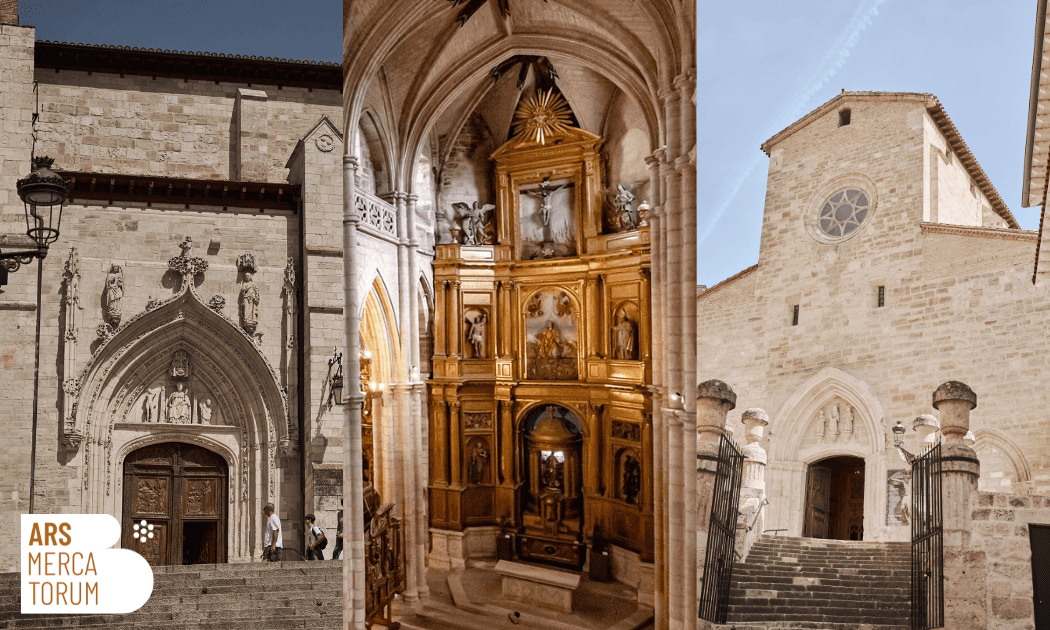
Church of San Nicolás de Bari. The setting of our own launch event, and not by chance: this is home to the stone altarpiece the organisers themselves have described as one-of-a-kind, alongside the Tapestry Museum, Spain's richest parish collection. A space that, as the parish priest himself admitted, remains a secret even to many locals.
Church of San Gil Abad. The great pantheon of Burgos's merchant families. Funerary chapels that speak of faith and status, and the haunting Christ of the Holy Drops, before which Philip II reportedly uttered words that have gone down in history.
Altarpiece Museum, at the church of San Esteban. The Route's third church, completing the panorama of sacred art financed by the merchant class.
Three churches. One story. Five centuries of history condensed into a walk that takes two to three hours.
Beyond the churches: the street that changed everything
The app accompanying the visit doesn't stop at religious buildings. It also takes visitors past the civic buildings that belong to this same story: Castilfalé Palace, the Casa del Cubo — now a pilgrim hostel — the Cathedral's Golden Staircase, and the Capitanía building, built on the site of the legendary Palace of the Four Towers.
Because the merchants' wealth didn't just fill churches with art. It reshaped the entire city. And that's exactly what we want visitors to understand as they walk the Renaissance "golden mile".
What we already knew before saying it out loud
Before this official launch, Ars Mercatorum went through a two-month pilot phase. No official communication, no complete signage, none of the institutional backing it has today. And still, nearly 9,000 people already visited the participating parishes.
That number confirmed something we'd suspected all along: there's real demand for cultural heritage in Burgos beyond the Cathedral. It just needed to be told properly.
Why one single ticket for three churches
Keeping these spaces open takes a serious financial effort from the parishes. Bringing everything together under one combined ticket makes that openness sustainable — staffing, upkeep and extended hours, all year round. It's a model that combines cultural value with the real-world viability of keeping this heritage alive and accessible.
How to experience the Merchants' Route
📍 Combined ticket for all three churches: €7
🕐 Opening hours: 11:30 AM to 7:00 PM, Monday to Sunday.
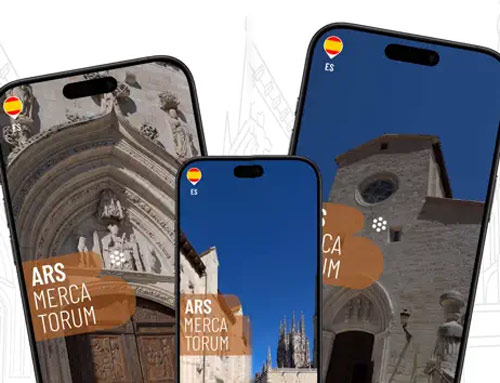
📱 Official app: free, with a multilingual audioguide, route map and visual content designed to make the visit intuitive, even for those less comfortable with apps.
👉 Book your ticket directly on our website.
It was about time someone said so
This summer, Burgos will experience moments that won't come around twice. The total solar eclipse on August 12 will fill hotels and streets with visitors chasing a spectacle in the sky. We're offering another one, closer to the ground: the one left behind by the merchants who turned this city into a European trading capital — carved in stone, woven into Flemish tapestries, and built into palaces you can still walk through today.
It's official. The Merchants' Route now runs through Burgos.
Because Burgos has far more to offer than its Cathedral. And it was about time someone said so.