
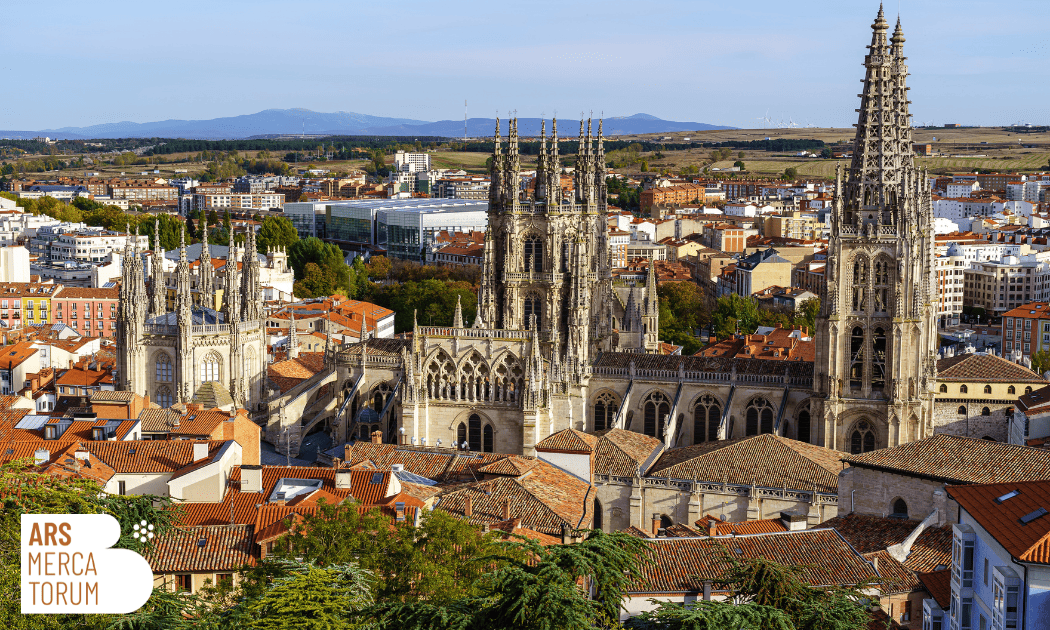
If you're looking for what to see in Burgos, chances are you already know the first answer: the Cathedral. Fair enough — it's the obvious, well-deserved starting point of any visit to the city. But most guides stop there, or list the rest of the city's monuments as if they were kilometres apart.
They're not. Burgos has one of the most compact, walkable historic centres in Spain, and some of its most important artistic treasures sit literally around the corner from the Cathedral. This guide takes you through the city's must-see monuments, starting with the most famous one — but not stopping there.
1. Burgos Cathedral
Let's start with the obvious, because here the obvious is more than justified. Burgos Cathedral has been a UNESCO World Heritage Site since 1984, one of the high points of Spanish Gothic architecture, with nearly eight centuries of history since its first stone was laid in 1221. Its openwork spires, the Constable's Chapel and the Golden Staircase are unmissable.
General admission costs €11 (according to the official Cathedral website, price in effect since April 2026), with reduced rates and limited free access on Tuesdays from 9:30 to 11:25 AM.
Give it at least an hour and a half. But when you step outside, don't walk away just yet.
2. The Merchants' Route: less than a minute away on foot
Just across the square, up a short flight of steps from the Cathedral itself, you'll come across the Church of San Nicolás de Bari. It's so close that many tourists don't even realise they can go in. That's a mistake, because inside awaits one of the most singular altarpieces in all of Spain: a late-Gothic masterpiece carved in stone — not wood, as was customary — with 464 meticulously sculpted figures by Simón and Francisco de Colonia, the same artists behind the Cathedral spires you just admired.
San Nicolás de Bari is part of the Merchants' Route, a walk of less than one kilometre through three churches that tell Burgos's other great story: that of the merchants who, through the international wool trade with Flanders, financed an artistic heritage that remains largely unknown to anyone who only visits the Cathedral.
Walking up Calle Fernán González, you'll also reach the Church of San Gil Abad, the great pantheon of the Burgos merchant class, with funerary chapels and the haunting Christ of the Holy Drops. And the Altarpiece Museum, in the church of San Esteban, with a collection of restored altarpieces from different periods.
The combined ticket for all three churches costs €7, with continuous opening hours from 11:30 AM to 7:00 PM, Monday to Sunday. If you've already paid for your Cathedral ticket, this is the best way to make the most of the rest of your morning without moving far from the spot.
3. Arco de Santa María
Heading down from the Cathedral toward the Arlanzón river, you'll find the Arco de Santa María, one of the historic gates of the old medieval city wall. Today it houses temporary exhibitions, and its sculpted façade — featuring figures of historical Burgos characters, including El Cid — is one of the city's most recognisable postcard shots.
4. Espolón Promenade
Just across the Arco de Santa María, the Espolón Promenade welcomes you with its row of centuries-old trees along the river. It's the perfect spot for a break, a coffee on a terrace, or simply watching local life go by before continuing your exploration.
5. Museum of Human Evolution
A few minutes' walk from the historic centre, the Museum of Human Evolution (MEH) displays original finds from the Atapuerca archaeological sites, just 15 km from the city and also a UNESCO World Heritage Site. It's the perfect alternative if you're after something completely different from the sacred art that dominates the rest of the itinerary: here, prehistory takes centre stage.
6. Monastery of Las Huelgas
A little further from the centre, but well worth the trip: the Monastery of Las Huelgas, founded by Alfonso VIII and Eleanor of England in the late 12th century, served for centuries as the pantheon of Castilian royalty. Its Romanesque cloister and medieval textile heritage make it a must for anyone wanting to dig deeper into Castile's medieval history.
7. Miraflores Charterhouse
A former royal leisure palace turned Carthusian monastery, the Miraflores Charterhouse houses the mausoleum of the Catholic Monarchs and their parents, John II of Castile and Isabella of Portugal. It's still home to a community of monks, lending it a contemplative character unlike any other visit in the city.
8. Burgos Castle
For the best panoramic views of the city, head up the hill to Burgos Castle. The viewpoint offers a bird's-eye perspective that helps make sense of how all the monuments you've just visited fit together: the Cathedral, the Merchants' Route and the rest of the historic centre, all packed into a surprisingly small radius.
The itinerary that saves you time
If you only have one day in Burgos, this is the most efficient order, taking advantage of the fact that almost everything is within walking distance:
- Early morning: Burgos Cathedral.
- Right after: Merchants' Route (San Nicolás de Bari, San Gil Abad and the Altarpiece Museum) — it's literally next door.
- Before lunch: Arco de Santa María and the Espolón Promenade.
- Afternoon: Museum of Human Evolution.
- Sunset: Burgos Castle, to look down on everything you've covered during the day.
And if you have a second day, add the Monastery of Las Huelgas and the Miraflores Charterhouse — a bit further from the centre, but easy to combine into a single day.
Why it's worth crossing the square
It's common to leave Burgos Cathedral, snap a photo of the Arco de Santa María, and move on without realising that, just a few steps away, one of the city's most singular artistic ensembles is hiding in plain sight. The Merchants' Route doesn't compete with the Cathedral — it completes it. It tells the other half of Burgos's story, that of the merchants who made this city one of the wealthiest in medieval Castile, in the time and at the price of an extra visit that many tourists miss simply because they don't know it's there.
Next time you visit the Cathedral, don't turn toward the Arco de Santa María without first climbing those few steps to San Nicolás de Bari. It's worth it.