
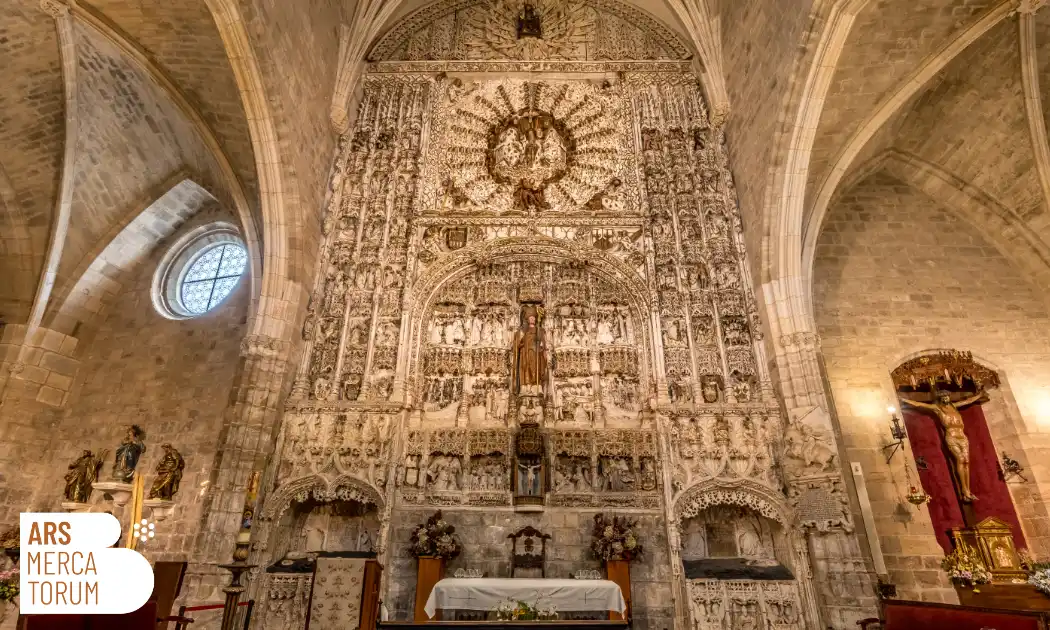
The St Nicholas altarpiece is the main altarpiece of the Church of St Nicholas of Bari in Burgos: a limestone work from Hontoria, about 15.55 × 9.04 metres and 464 sculptures, paid for by the merchant Gonzalo López de Polanco (who died in 1505) and attributed to the master masons Simón and Francisco de Colonia. It is the only stone altarpiece to survive from late medieval Burgos, and you can see it for €4 as part of the Merchants’ Route (Ars Mercatorum), about 140 metres from the Cathedral.
Updated: October 2026

What is the St Nicholas altarpiece in Burgos?
The St Nicholas altarpiece dominates the east end of the Church of St Nicholas of Bari, on Calle Fernán González, right behind the Cathedral and next to the Camino de Santiago. The parish is already mentioned in 1163, and the present building began to go up in 1408 on the site of an earlier Romanesque church.
What you see on entering is a wall of carved stone from floor to vault, not a painting or a gilded wooden carving. Scenes from the life of St Nicholas, biblical episodes and the Coronation of the Virgin share a single composition of 464 figures.
Why it is exceptional
Two features set it apart from other Castilian altarpieces of its time. In size, it is the largest carved altarpiece commissioned by a private patron in late medieval Burgos. In material, it is the only stone one to survive from that period in the city. Here are the key facts:
| Fact | Detail |
|---|---|
| Work | Main altarpiece of the Church of St Nicholas of Bari, Burgos |
| Material | Limestone from Hontoria |
| Size | 15.55 × 9.04 m |
| Sculptures | 464 |
| Patron | Gonzalo López de Polanco, Burgos merchant (died 1505) |
| Authorship | Workshop of Simón de Colonia and his son Francisco de Colonia |
| Church | National Monument since 26 January 1917 |
| Location | Calle Fernán González, about 140 m from the Cathedral |
Who made the St Nicholas altarpiece?
Authorship is shared between two names from the same family of master masons, the Colonias: Simón de Colonia and his son Francisco de Colonia. Sources do not fully agree: the Castile and León tourism portal (in Spanish) highlights the stone altarpiece by Simón de Colonia, other listings credit Francisco and several describe it as the work of both. The safest wording is the Colonia workshop, with Francisco as the sculptor documented as commissioned for the titular image.
The work was paid for by Gonzalo López de Polanco, a Burgos merchant who died in 1505. At the foot of the altarpiece are the tombs of Gonzalo López de Polanco and his wife, Leonor de Miranda, and those of Alfonso de Polanco and Constanza de Maluenda. That is why it is described as an altarpiece-tomb: a work that served as both altar and family memorial.
That origin explains the whole church. Burgos lived on wool and on trade with Flanders and Italy, and the merchants who funded the church had links across Europe; some even had their own trading house in Florence. It is the same world that the Merchants’ Route follows today.
Why the St Nicholas altarpiece is made of stone, not wood
In Castile around 1500, large altarpieces were usually carved in wood and then polychromed and gilded. The high altarpieces of the cathedrals of Seville, Toledo and Oviedo and of the Carthusian monastery of El Paular, of comparable scale and made between about 1482 and 1505, are mostly polychrome wood.
Here something different was done. The merchants chose Hontoria limestone, a stone already used in Burgos Cathedral but almost never for altarpieces. The Merchants’ Route itself speaks of “woven stone” and “stone goldsmithing” because of the fineness of the work.
What to look for among the 464 figures
With so many figures it helps to know what to look for. This table sums up the main motifs according to the tourist listings for the church:
| Motif | What it shows |
|---|---|
| Miracles of St Nicholas | The best-known episodes: he gives three bags of gold to secure the future of three young women and restores three children to life. The main scene brings together eight miracles from his life. |
| Biblical scenes | Several Bible passages, carved alongside the life of the saint. |
| Coronation of the Virgin | One of the central scenes of the composition. |
| Polanco tombs | At the base, with the coats of arms of the patron family. |
Your ticket includes the free Ars Mercatorum guide app, with multimedia content, which helps you identify the scenes without losing the thread. It is worth spending a few minutes on this altarpiece alone before moving on to the rest of the church.
Beyond the altarpiece: Last Judgement, tapestries and tombs
The church holds more treasures. The Great Panel of the Last Judgement, in the Hispano-Flemish style, sets a luminous paradise against the realism of the damned and the demons. The church museum keeps Flemish tapestries, with the Jacob tapestries as a reference, and a 15th-century Christ of the Agony of striking anatomical realism. The tombs follow the late Gothic Burgos model: dark slate for the robes and white alabaster for faces and hands.
If the subject grabs you, complete the route with the Museum of the Altarpiece, in the former church of San Esteban, and San Gil Abad church, built into the city wall. Here is also what to see 5 minutes from Burgos Cathedral.
How to see the St Nicholas altarpiece: price, hours and tickets
These are the practical details for visiting the church:
| Item | Detail |
|---|---|
| Single ticket | €4 (reduced, €3) |
| Combined ticket, 2 churches | €6 |
| Combined ticket, 3 churches | €7 |
| General opening hours | 11:30 to 19:00 |
| Last entry | 18:30 |
| Free entry | Tuesdays from 17:00 to 19:00 |
| 24 and 31 December | Closed in the afternoon |
| Address | Calle Fernán González, Burgos |
Opening hours can change. Before you go, check the rates and schedules page or our guide to visiting the Merchants’ Route without queues.
Frequently asked questions
Who made the St Nicholas altarpiece in Burgos?
It came out of the Colonia workshop: Simón de Colonia and his son Francisco de Colonia. It was paid for by the Burgos merchant Gonzalo López de Polanco, who died in 1505. Some sources give more weight to Simón and others to Francisco, who is documented as the sculptor of the titular image.
How many figures does the main altarpiece of St Nicholas have?
It has 464 limestone sculptures from Hontoria, arranged in a composition of about 15.55 × 9.04 metres. It shows scenes from the life of St Nicholas, biblical episodes and the Coronation of the Virgin.
Why is it special that the altarpiece is made of stone?
Because in Castile around 1500 large altarpieces were usually made of polychrome wood. The St Nicholas altarpiece is the only stone altarpiece to survive from late medieval Burgos and the largest carved on private commission in that period.
How much does it cost to see the altarpiece and what are the opening hours?
A single ticket costs €4 (reduced, €3). Combined tickets are €6 for 2 churches and €7 for 3. General opening hours are 11:30 to 19:00, with last entry at 18:30, and entry is free on Tuesdays from 17:00 to 19:00.
Is it close to Burgos Cathedral?
Yes. The Church of St Nicholas of Bari is on Calle Fernán González, about 140 metres from the Cathedral and next to the Camino de Santiago, so it is a few minutes on foot.
See the St Nicholas altarpiece in person. Buy your ticket online for the Merchants’ Route (Ars Mercatorum) from €4 and combine St Nicholas with San Gil Abad and the Museum of the Altarpiece for €7 with the 3-church combined ticket. Buy tickets for the Merchants’ Route.